

 article
 Equable Original
Equable Institute has issued updated Retirement Security Policy Scorecards for California Assembly Bill 1383 (AB1383). You can view the prior scorecards here.
Editor’s note: The text below reflects the latest amendments introduced to AB 1383 in mid-May 2026.
AB 1383 was introduced during the 2025 session and placed on a two-year track to progress through the legislature. In January of 2026, it was passed by the General Assembly and sent to the Senate, at which point we analyzed the bill. On May 13, 2026, AB 1383 was amended in the Senate Committee on Labor, Public Employment, and Retirement.
The amendments introduced to the bill make several notable changes that are reflected in this text, but these changes do not change the underlying analyses in the scorecards we issued in February. The specific policy changes will have an actuarial impact on the future costs for both the California Public Employees Retirement System (CalPERS) and the California State Teachers’ Retirement System (CalSTRS), so Equable encourages policymakers to thoroughly review the amended bill and how its fiscal impact may change.
AB 1383 aims to lower the normal retirement age for public safety employees enrolled in CalPERS. The most recent amendments have clarified that the benefit multipliers for most employees would remain the same; however, there would be an opportunity for CalPERS employers and labor representatives to collectively bargain for potential multiplier increases. It is also notable that previous provisions that would have modified the cost-sharing agreement to allow collective bargaining agreements that would shift some required member contributions onto employers have been removed.
After analysis of the most recent version, Equable’s assessment finds that retirement benefits would be slightly better overall for workers under the current proposal.
Currently, there are three levels of benefits offered to CalPERS public safety employees depending on the collective bargaining agreements struck with each local municipality. Under the amended version in the Senate, multipliers would remain at their current levels unless otherwise agreed upon by employers and labor representatives via updated collective bargaining agreements.
For our analyses, we examine if multipliers shift from 2% to 2.5%, 2.5% to 2.7%, and 2.7% to 3%, depending on the employer contract. This aligns with the previous iteration of the bill and illustrates how benefits could change. We note that most members are enrolled in the plan that currently offers a 2% multiplier at normal retirement.
The amended AB 1383 does maintain that the retirement age would shift from 57 to 55 for all workers enrolled in these plans. As a result, benefits will be slightly better, even if multipliers do not change.
According to our assessment, the proposed benefit changes would provide slightly more valuable benefits to workers who serve more than 10 years. Most full-career employees (those with more than 20 years of service) would see their lifetime benefits grow by more than $300,000. Medium-term workers (10 to 20 years of service) would see their benefits increase by more than $100,000 in value. Short-term workers would see no change in benefit values.
To illuminate the impact on different workers across each of the three benefit levels, Equable has produced three scorecards for this bill.
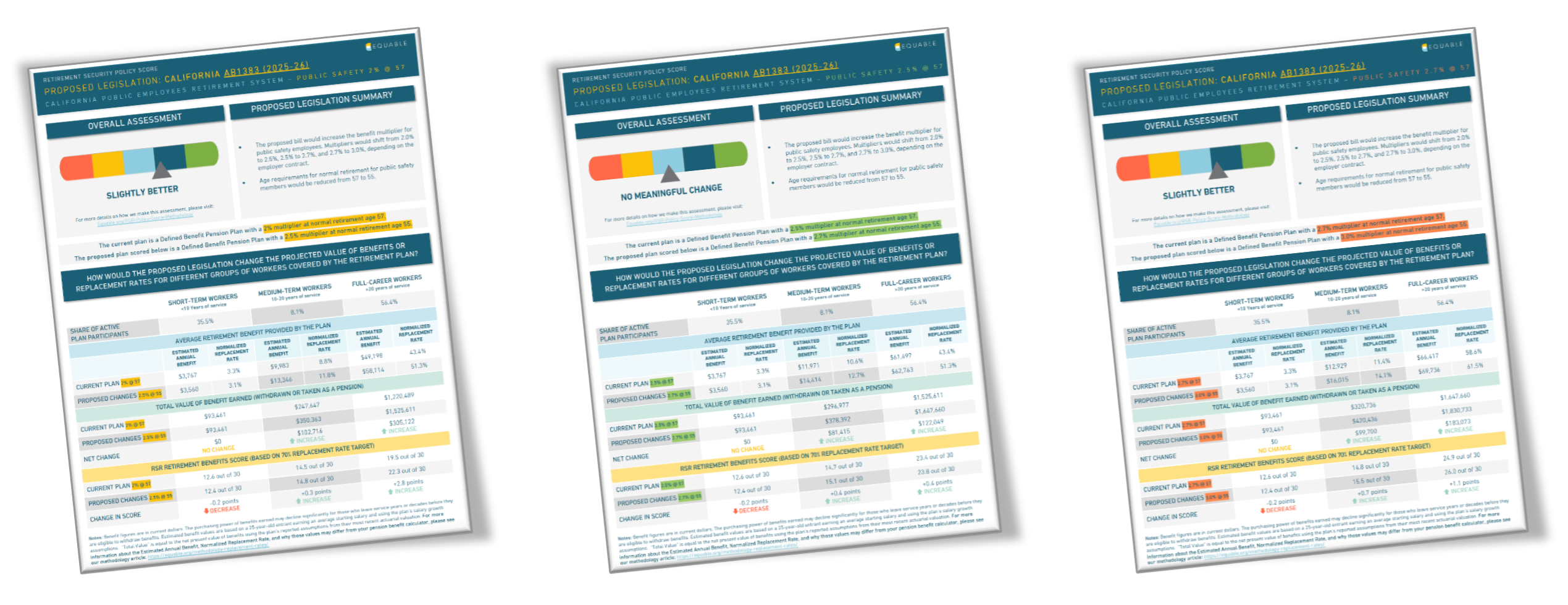
DOWNLOAD THE 2% MULTIPLIER SCORECARD
DOWNLOAD THE 2.5% MULTIPLIER SCORECARD
DOWNLOAD THE 2.7% MULTIPLIER SCORECARD
In addition to the provisions shown in our scorecards, the amended AB 1383 also has several other important components for California public employees:
- The maximum pensionable compensation for workers not enrolled in Social Security is increased. The current level is 120% of the Social Security wage base, which would be elevated to 135%.
- The change in the maximum pensionable compensation for workers not enrolled in Social Security would be extended to not just CalPERS safety members but for all CalPERS and CalSTRS members.
- Members of the 3% @ 55 tier would have their benefits capped at 90% of pre-retirement salary.
While these changes do not affect the analyses in our scorecards, they do reflect important changes to the bill that would likely have an impact on some members of CalPERS and CalSTRS. If the bill is amended further in a way that would affect our assessment of the quality of benefits, we will update our scorecards accordingly.
EQUABLE INSTITUTE’S ANALYSIS OF CALIFORNIA ASSEMBLY BILL 1383
Positive Elements of California Assembly Bill 1383:
- The proposed pension reforms would result in an increase in the estimated total benefits for most public safety workers. While Short-Term Workers (who work 10 years or less) would not see a change in their total benefits, Medium-Term Workers (who work 10 to 20 years) would see benefits raised by over $100,000, and Full-Career Workers (who work 20+ years) would have their benefits grow by more than $300,000.
- Employers would be set to automatically shift their contracts to the nearest new multiplier group but technically retain the ability to choose a new contract for their employee benefits, such that they can adopt a different benefit rate if they can reach a new agreement via collective bargaining. For instance, those employers at the 2.7% @ 57 group are not locked into the 3% @ 55 group if they negotiate to a different rate.
Negative Elements of California Assembly Bill 1383:
- Short-Term Workers do not see any notable improvement from the reforms proposed in AB 1383. In both the existing plan and proposed enhanced plan, these members still stand to maximize their benefit by taking a refund of their contributions plus interest.
- This enhancement of benefits is intended to improve recruiting and retention for California’s public safety employees. However, there is limited evidence to suggest that such an enhancement will achieve the stated policy goal.
- As of June 30, 2025, CalPERS reported a net pension liability of $43.19 billion. This means that the plan has almost $45 billion less than it needs to pay the benefits already earned. There currently is no actuarial analysis or estimate for the cost of AB 1383, raising the question of how much it will cost for CalPERS to offer these benefit enhancements.


