
Normal cost is the contribution necessary, when added to investment income, to pay for benefits earned each year. It “prefunds” or “pays in advance” for promised pension benefits.
Normal cost is usually presented as a percentage of total salary earned by all employees in the public pension system. This makes it easy to calculate the contribution rates for both members and their employers as a group.
Who Pays for Normal Cost?
As illustrated below, both employee contributions and employer contributions pay for normal cost.
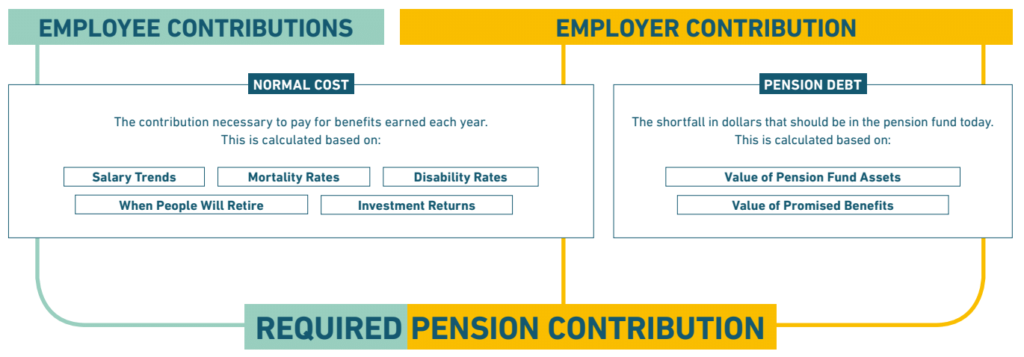
Take the Georgia Teachers’ Retirement System, for example. Suppose that when the actuaries get together to measure the payments necessary for your future pension, they determine 14.65% of your salary would be the appropriate amount, which is what Georgia’s actuaries estimate as of 2025. Your state might require you to pay a portion of this — Georgia asks for 8.65% — while it would pick up the rest (in this case, 8.65%).
Typically, the amount of money taken out of each paycheck you receive for retirement benefits is the employee share of normal cost. Some pension systems also make payroll deductions for health care plans or retiree insurance plans.
In the case of Georgia TRS, the way that normal cost is paid for looks like this:
- Gross Normal Cost: 14.65% of payroll
- Employee Contribution: 6% of each paycheck
- Employer Share: 8.65% of payroll
Examples of Employee vs. Employer Contributions
Below are several additional examples of how different retirement systems split normal cost payments between employees and employers, as of 2025.
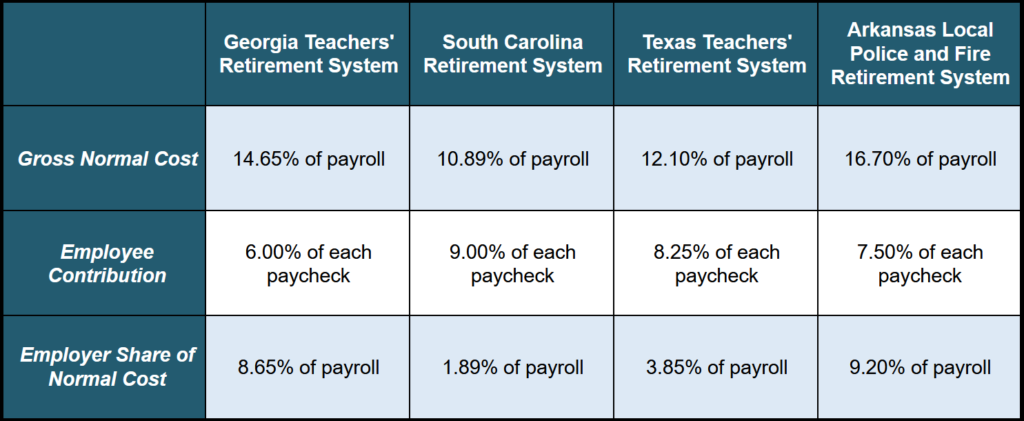
The South Carolina Retirement System and Texas Teachers’ Retirement System require a much larger employee contribution compared to the employer share of normal cost, whereas the opposite is true for the Arkansas Local Police and Fire Retirement System and the aforementioned Georgia TRS.
Gross normal cost is the combined total of employee and employer contributions.
This article is part of Equable’s Pension Basics series. To learn more about how your pension works, check out the other articles in the series:
1. How Pension Benefits Are Calculated
2. Vesting
3. The Pension Funding Formula
5. Normal Cost
6. Unfunded Liabilities (aka Pension Debt)
7. Actuarially Determined Contributions
10. Governance
11. Pension Myths & Facts: The Assumed Rate of Return Does Not Determine the Value of Benefits
12. Pension Myths & Facts: The Funded Status of Pension Plans Does Not Depend on More Public Employees