

Public Pension Benefits
Research, news, and analysis on how pension benefits are structured, what drives changes to them, and what they mean for the workforce and the public.
Public retirement benefits provide millions of employees with financial security after their careers in public service.
Public retirement benefits represent a fundamental compact between governments and the workers who serve their communities. Understanding how these benefits work and how they have changed over time is essential for employees planning for retirement, policymakers designing sustainable systems, and governments managing long-term fiscal obligations.
Equable’s research shows that the value of pension benefits has declined for many public workers over recent decades, with potential implications for workforce recruitment, retention, and retirement security. The strength of these benefits is directly tied to the financial wellbeing of workers, the stability of the governments that fund them, and the health of the communities they serve.
Featured Research
The Retirement Security Report, 2nd Edition
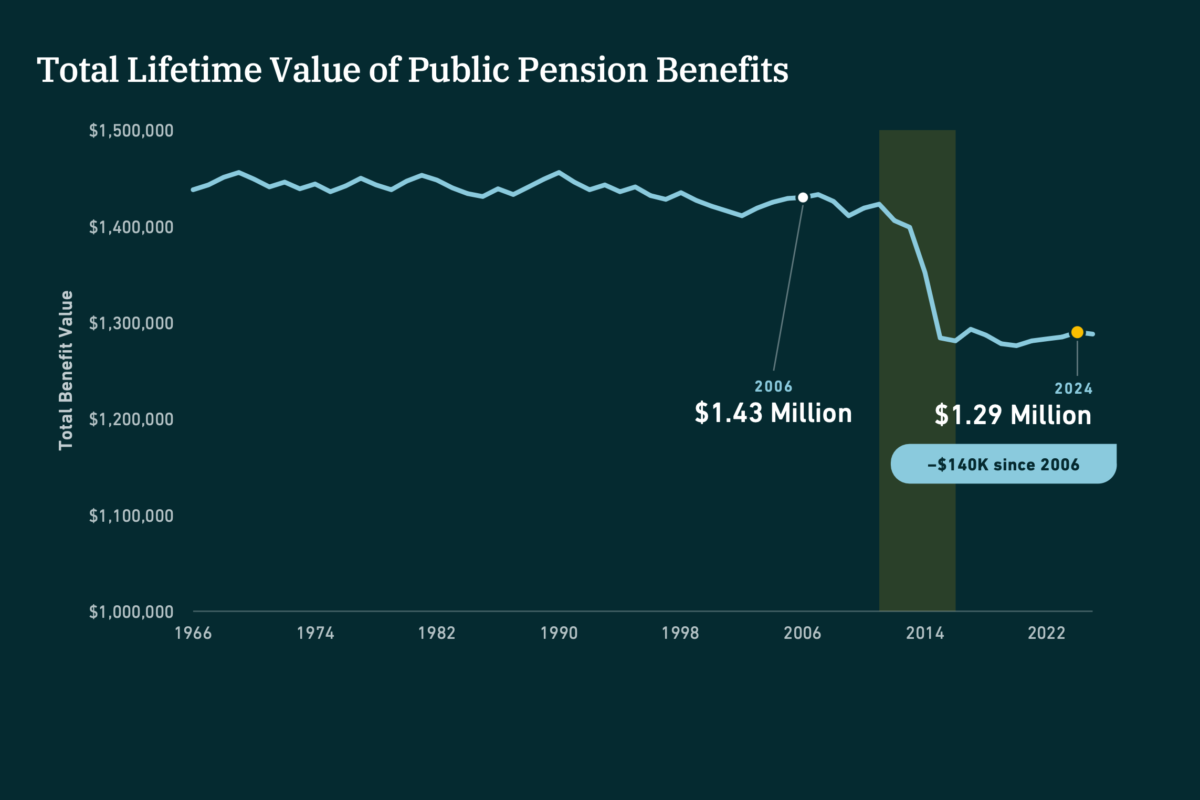
The expected lifetime value of retirement benefits for a typical full-career public employee has dropped by more than $140,000 since 2006.
Latest
Featured Resources on Benefits
Research, data, analysis, and educational content on public retirement system benefits


Pension Benefit FAQs
Answers to common questions about how public retirement benefits work
The value of your defined benefit payment in retirement is typically calculated using the following formula: [Years of Service X Multiplier X Final Average Salary]. To find out if your plan provides adequate income in retirement, look up your plan’s interactive scorecard in our The Retirement Security Report.
Most public employees in the United States must work for at least five to seven years to qualify for any pension benefits. This is known as vesting. For employees who leave their job before vesting, they typically are entitled to receive only a return of their own contributions. To qualify for benefits from a traditional pension system, a public employee must meet certain requirements, which are typically based on age and years of service. Consult your plan’s handbook for specific details about vesting and your eligibility to claim benefits.
Eligibility for a public pension depends on your employer and the retirement system that covers your job. Generally, full-time employees of state or local governments — including teachers, police officers, firefighters, and other civil servants — are automatically enrolled in a defined benefit pension plan as a condition of employment. Some systems also cover part-time employees who work above a minimum hours threshold. Eligibility rules vary significantly by state, employer, and employee category, so it’s important to check the specific rules of your plan.
Retirement eligibility depends on your plan’s rules, which typically combine age and years of service. Many plans use one of the following structures:
- Age + service requirement: You must reach a minimum age (commonly 60 or 65) and have a minimum number of years of service (often 5 or 10).
- Rule of X: Your age and years of service must add up to a specific number — for example, “Rule of 80” means you can retire when your age plus years of service equals 80.
- Service-only: Some plans allow retirement after a set number of years regardless of age (commonly 20 or 25 years).
Most plans also allow early retirement before the standard eligibility threshold, but with a reduced monthly benefit. In recent years, many states have raised retirement ages and extended service requirements for new hires, so the rules that apply to you may differ from those of longer-tenured colleagues. Always confirm your eligibility requirements directly with your plan administrator.
Newsletter