

Pension Investment Policy
Find research, data, news, and analysis on how public retirement systems manage assets, allocate capital, and navigate an evolving investment landscape.
The investment strategies and policies public pension funds employ play a critical role in securing long-term financial stability.
Public pension funds are among the largest institutional investors in the world, managing trillions of dollars in assets on behalf of millions of public workers and retirees. The investment strategies and policies these funds employ directly shape their ability to meet long-term obligations to beneficiaries, while minimizing the fiscal burden on governments and taxpayers. Decisions around asset allocation, risk management, and investment governance have consequences that extend well beyond the fund itself — affecting public employees’ retirement security, government finances, and the broader communities these systems serve.
Featured Research
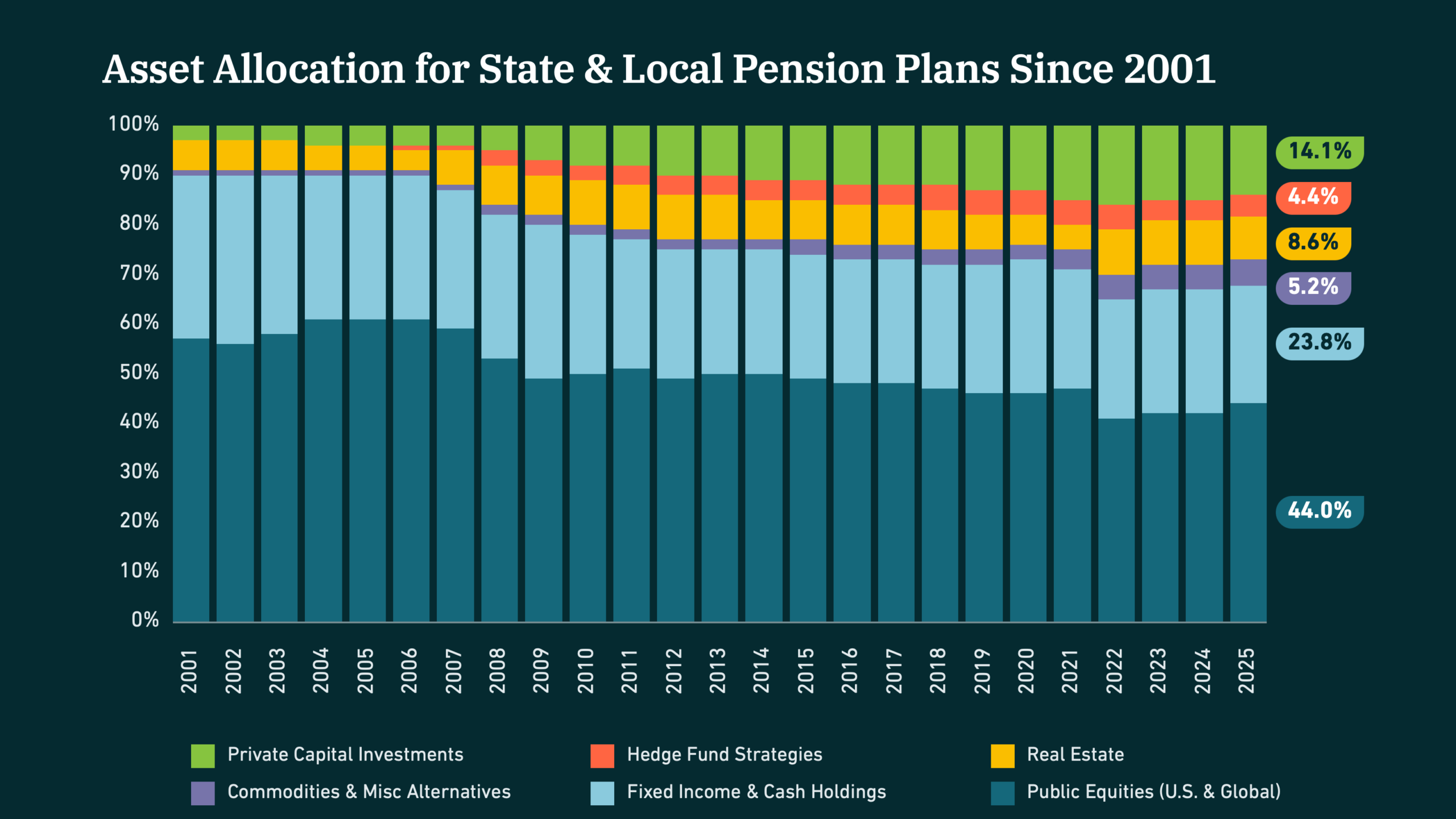
Alternatives account for one third of pension investments
Over the past 15 years, pension fund assets have steadily shifted into alternatives. This includes private equity, real estate, hedge funds, commodities and other miscellaneous investments. While some of that money has come out of fixed income products, the shift has mainly been at the expense of publicly traded equities.
Most of these investments have added some combination of asset risk, illiquidity risk, and/or lack any meaningful transparency. Read more in State of Pensions 2026.
Featured Resources on Investment Policy
Research, data, analysis, and educational resources on public retirement investment policy.


Pension Investment Policy FAQs
Answers to common questions about public pension investments.
Unlike 401(k)s or IRAs, in which the account holder chooses their own investments, investment decisions for the assets within your pension plan are made by the pension board. The pension board holds a fiduciary responsibility as to the administration of benefits and investment of assets, meaning they are bound to make decisions in the best interest of public workers.
Pension plan assets are invested in a wide range of asset classes, such as stocks, bonds, real estate, private capital, hedge funds, and/or alternatives. To see the investment mix for your pension plan, check out our interactive Financial Resilience Report tool. Select your state, system, and plan to see details about how plan assets are allocated.
Divestment decisions should be driven by investment strategy — not politics. Pension fund managers have a fiduciary duty to act in the financial interests of the workers whose money they manage, and research shows funds with divestment requirements tend to underperform those without.
Divestment can be justified when a comparable replacement investment exists. But blanket mandates driven by political goals are harder to square with fiduciary duty — and the burden of proof should always be on demonstrating that workers’ financial interests won’t be harmed.