

How does a state, or the fund administering pension benefits, ensure it’s able to pay promised retirement income to public workers when they retire?
The answer boils down into a simple idea: Retirement systems work to make sure that contributions into the pension fund, plus investment returns on that money, match the value of benefits promised to public workers, plus expenses to run the pension plan.
The Pension Funding Formula
Expressed as a formula, the process looks like this: Benefits + Expenses = Contributions + Investment Returns.
How Pension Benefits are Funded
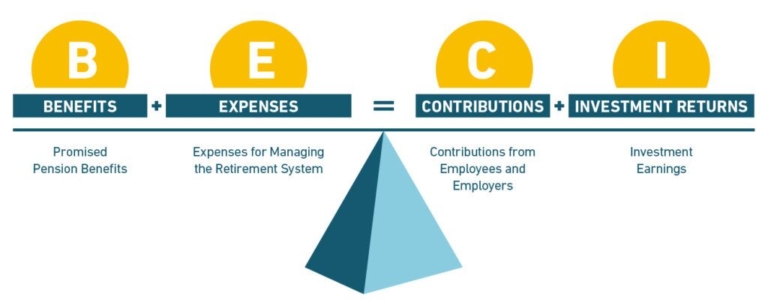
How Are Pension Benefits Funded?
The pension plan funding formula has three basic steps.
Step 1: Estimating Benefits
The first step is to estimate the value of all benefits earned. Actuaries look at the benefits offered by the pension plan, the rules for vesting, and the qualifications for claiming a retirement benefit. They make educated guesses about what salaries public workers will earn, when they will retire, and how long they will live. Using this information, actuaries then estimate how much retirement income a pension system will need to pay out each year in the future and what the value of all those promised payments are worth today.
Put simply, actuaries take a guess at how many pension checks will be paid out in the future, what the value of those checks will be, and then count them all up to figure out what that money is worth in current dollars. The result is the value of promised pension benefits, which is the first major component in the formula above.
Expenses
Of course, there are costs in running a pension fund that are separate from the benefits it’s obligated to pay out. Salaries for staff, money to process checks, and resources to build tools that workers can use to manage their future retirement must be factored into the equation. Expenses are usually a very small amount relative to the assets the fund manages, and these are easily added to the cost of benefits.
Step 2: Making Contributions
The next step in funding a pension plan is getting money into the pension fund. Contributions are the amount of money paid into a pension fund from public workers, employers (such as school districts, police departments, or municipal agencies), and other government sources (such as the general state budget).
Actuaries make an assumption about how much these contributions will grow once they are invested. Using this assumed rate of return, actuaries determine how much should be contributed in a given year to pay in advance for all of the benefits earned in that year.
The greater the returns actuaries expect investments will earn, the lower the amount of contributions the fund needs today. Conversely, the lower the assumed investment returns, the more contributions are needed today. Whatever the assumptions, though, some amount of contributions need to flow into the pension fund.
Step 3: Earning Investment Returns
The final step is simply earning investment returns. Once a contribution rate is set and that money flows into the pension fund, it is up to the pension board and investment managers to make sure that actual rates of return are at least as good as expectations.
When everything is working, the value of benefits plus expenses will match the appropriate amount of contributions plus investment returns. If any of these elements is out of balance, the pension system could be underfunded. If actuaries don’t accurately estimate the size of benefits, then contributions and investments won’t be enough to cover them. And if states don’t make appropriate contributions, or investment returns don’t perform as expected, funds could run short.
This article is part of Equable’s Pension Basics series. To learn more about how your pension works, check out the other articles in the series:
1. How Pension Benefits Are Calculated
2. Vesting
3. The Pension Funding Formula
5. Normal Cost
6. Unfunded Liabilities (aka Pension Debt)
7. Actuarially Determined Contributions
11. Pension Myths & Facts: The Assumed Rate of Return Does Not Determine the Value of Benefits
12. Pension Myths & Facts: The Funded Status of Pension Plans Does Not Depend on More Public Employees