Pension benefits are typically a fixed monthly payment in retirement that is guaranteed for life. Some pension benefits grow with inflation via cost-of-living adjustments. Other pension benefits can be passed on to a spouse or dependent after your death.
What makes pensions unique, however, is that the retirement income benefit is determined by a formula that does not take into account the amount of money actually saved. In other words, the amount of the pension stays the same even if the retirement system isn’t keeping up with saving money to pay the benefit.
Looking to estimate your own pension benefit? Use our pension calculator.
The Pension Benefit Formula
A typical pension benefit formula is: Years of Service ✕ Multiplier ✕ Final Average Salary.
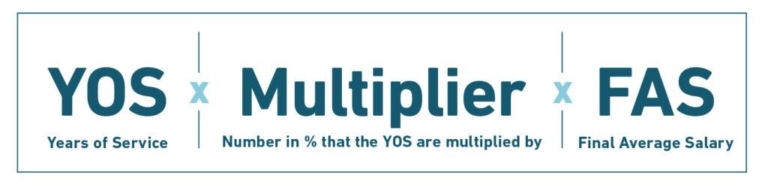
- Years of Service: In the formula above, YOS is how many qualifying years a public worker has worked for their employer within the pension plan.
- Final Average Salary: This figure is defined slightly differently from state to state but always is a reference to the compensation amount that a pension is based on. In most states, FAS — also called final average compensation — is the average of the last three or five years of work. Other states use the three or five highest years of salary, rather than the years at the end of your career.
- Multiplier: This number, sometimes known as “accrual rate” or “crediting rate,” is used to determine the percentage of final average salary that is received as a retirement benefit. Years of service are multiplied by this specific number. That amount becomes a percentage of final average salary. And the result equals the amount ultimately received as a benefit in retirement. The higher the multiplier, the larger the benefit.
Example
A typical multiplier is 2% (0.02). So, if you work 30 years and your final average salary is $75,000, then your pension would be calculated as follows: 30 ✕ 0.02 ✕ $75,000 = $45,000 of guaranteed annual income for life.
Your years of service times the multiplier (in this case, 30 ✕ 2% = 60%) is known as your “replacement rate,” or the percentage of your final average salary that you’ll ultimately receive.
To find out if your retirement plan will provide adequate income, look up your plan’s interactive scorecard in the Retirement Security Report
This article is part of Equable’s Pension Basics series. To learn more about how your pension works, check out the other articles in the series:
1. How Pension Benefits Are Calculated
2. Vesting
3. The Pension Funding Formula
5. Normal Cost
6. Unfunded Liabilities (aka Pension Debt)
7. Actuarially Determined Contributions
10. Governance
11. Pension Myths & Facts: The Assumed Rate of Return Does Not Determine the Value of Benefits
12. Pension Myths & Facts: The Funded Status of Pension Plans Does Not Depend on More Public Employees